
Real estate remains one of the most trusted investment options for individuals and families seeking financial security, long-term wealth creation, and stability.
Should you buy a plot of land or purchase an existing house?
Both options offer unique advantages and challenges. While buying land provides flexibility and potentially higher appreciation, purchasing an existing house offers immediate usability and convenience. The right choice depends on your financial goals, lifestyle preferences, investment horizon, and risk tolerance.
This detailed guide compares buying land and purchasing an existing house, helping you make an informed decision based on long-term benefits, costs, and future returns.
Understanding Land Purchase
Buying land means acquiring a vacant plot without any construction. The buyer gains ownership of the property and can decide how and when to develop it.
Land investments are often considered a long-term wealth-building strategy because land is a finite resource. As urbanization expands and infrastructure develops, land values can increase significantly over time.
Advantages of Buying Land
1. Higher Appreciation Potential
Land generally appreciates faster than buildings because buildings depreciate with age while land remains a permanent asset.
Areas experiencing rapid infrastructure development, such as new highways, metro corridors, industrial parks, and IT hubs, often witness substantial land value appreciation.
2. Lower Initial Investment
In many locations, especially developing suburbs and emerging cities, plots are available at lower prices than constructed homes. This makes land ownership accessible to first-time investors.
3. Freedom to Build
Buying land allows complete control over the design, size, and construction quality of your future home.
You can build according to your requirements, budget, and family needs rather than adapting to an existing structure.
4. Minimal Maintenance Costs
Vacant land requires very little maintenance compared to a residential building.
There are no repair costs for plumbing, electrical systems, roofing, painting, or structural wear and tear.
5. Flexible Investment Strategy
Landowners can:
- Hold the property for appreciation.
- Build a house later.
- Develop commercial structures.
- Sell portions of the land.
- Lease it for specific purposes.
This flexibility makes land an attractive investment option.
Disadvantages of Buying Land
1. No Immediate Income or Occupancy
Unlike a ready house, vacant land cannot provide immediate accommodation unless construction is completed.
2. Construction Costs Are Additional
After purchasing land, owners must spend on:
- Architectural planning
- Government approvals
- Construction materials
- Labor charges
- Utility connections
Construction costs can significantly increase the overall investment.
3. Financing Challenges
Banks generally offer lower loan amounts and shorter repayment periods for land purchases compared to home loans.
4. Longer Waiting Period
The benefits of land ownership may take years to materialize, especially if the surrounding area develops slowly.
Understanding Existing House Purchase
Purchasing an existing house means buying a ready-to-move-in residential property. It may be an independent house, villa, townhouse, or resale property.
For many buyers, a ready house provides immediate convenience and eliminates the uncertainty associated with construction.
Advantages of Purchasing an Existing House
1. Immediate Occupancy
One of the biggest benefits is that you can move in immediately after completing the purchase process.
This is ideal for families seeking instant housing solutions.
2. Easier Financing
Banks generally provide attractive home loan options with:
- Lower interest rates
- Higher loan eligibility
- Longer repayment tenures
This reduces the financial burden on buyers.
3. Predictable Costs
The purchase price is largely fixed, making budgeting easier.
Buyers avoid unexpected construction cost escalations and project delays.
4. Established Infrastructure
Most existing homes are located in developed neighborhoods with:
- Roads
- Water supply
- Electricity
- Schools
- Hospitals
- Shopping centers
This adds convenience and improves quality of life.
5. Rental Income Opportunity
A ready house can generate rental income immediately, creating an additional revenue stream.
Disadvantages of Purchasing an Existing House
1. Building Depreciation
Although land appreciates, the structure itself depreciates over time.
Older homes may require renovations and repairs.
2. Limited Customization
Buyers often need to compromise on layout, design, room sizes, and architectural preferences.
3. Higher Maintenance Expenses
Homeowners must regularly spend on:
- Painting
- Plumbing repairs
- Electrical maintenance
- Roof repairs
- Structural upkeep
These recurring costs can be significant over the years.
4. Higher Purchase Price
Ready houses often cost substantially more than vacant plots in the same locality due to construction and infrastructure costs.
Cost Comparison: Land vs Existing House
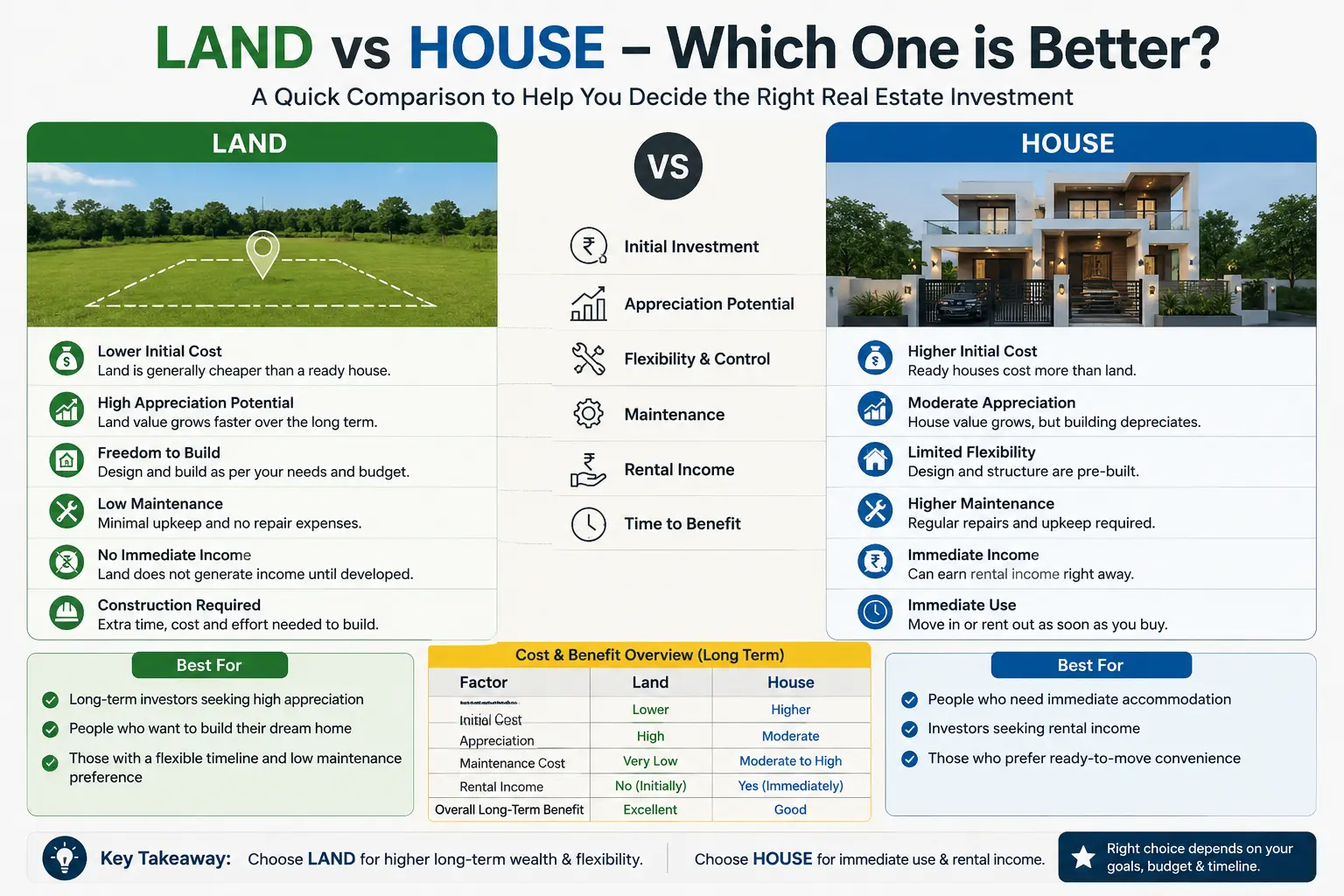
| Factor | Buying Land | Purchasing Existing House |
| Initial Investment | Lower | Higher |
| Immediate Occupancy | No | Yes |
| Construction Required | Yes | No |
| Maintenance Cost | Very Low | Moderate to High |
| Loan Availability | Moderate | Excellent |
| Rental Income | Not Available Initially | Immediate |
| Appreciation Potential | High | Moderate |
| Flexibility | Very High | Limited |
| Depreciation | None | Building Depreciates |
| Long-Term Wealth Creation | Excellent | Good |
Long-Term Financial Benefits Comparison
Scenario 1: Investor Seeking Wealth Creation
If your objective is long-term capital appreciation, land often outperforms residential buildings.
As cities expand outward, land scarcity increases, pushing property values upward. Since buildings depreciate over time, a significant portion of a house’s future value still depends on the underlying land.
Winner: Land
Scenario 2: Family Seeking Immediate Residence
Families who need a home immediately may find an existing house more practical.
There is no waiting period, construction management, or uncertainty regarding project completion.
Winner: Existing House
Scenario 3: Rental Income Generation
A house can start generating rental income immediately after purchase.
Vacant land typically does not provide regular cash flow.
Winner: Existing House
Scenario 4: Low Maintenance Investment
Investors looking for a passive asset with minimal upkeep generally prefer land.
There are fewer maintenance responsibilities and lower recurring expenses.
Winner: Land
Scenario 5: Custom Dream Home
If you want complete control over design and construction quality, buying land first is the better option.
You can build according to your budget and future family requirements.
Winner: Land
Important Factors to Consider Before Deciding
Location
Location remains the most important factor in real estate investment.
A strategically located plot may outperform an average residential house over the long term.
Budget
Determine whether your budget can comfortably accommodate:
- Land purchase
- Construction expenses
- Registration charges
- Future development costs
Purpose of Purchase
Ask yourself:
- Is it for living?
- Is it for investment?
- Is it for rental income?
- Is it for retirement planning?
The answer often determines the better choice.
Infrastructure Development
Check upcoming projects such as:
- Metro rail corridors
- Expressways
- IT parks
- Industrial zones
- Educational institutions
These developments can significantly influence property appreciation.
Legal Verification
Whether buying land or a house, always verify:
- Title documents
- Encumbrance Certificate
- Patta and Chitta records
- Building approvals
- Tax receipts
- Ownership history
Proper due diligence protects against future disputes.
Which Option Offers Better Long-Term Returns?
From a pure investment perspective, land generally provides stronger long-term appreciation because:
- Land is limited in supply.
- Maintenance costs are minimal.
- There is no structural depreciation.
- Urban expansion drives demand.
However, if your objective includes immediate use, rental income, and housing security, purchasing an existing house may provide greater practical benefits.
Investors focused on wealth creation often choose land, while end-users seeking convenience and instant occupancy typically prefer a ready house.
Conclusion
The decision between buying land and purchasing an existing house depends entirely on your financial goals and personal requirements.
If your primary objective is long-term wealth creation, capital appreciation, flexibility, and lower maintenance costs, buying land can be a highly rewarding investment. Land remains one of the strongest assets for building future wealth, especially in growing locations with strong infrastructure development.
On the other hand, if you need immediate accommodation, stable rental income, easier financing, and a hassle-free ownership experience, purchasing an existing house is often the better choice.
Before making any decision, evaluate your budget, investment horizon, future plans, and the growth potential of the location. A well-researched real estate investment—whether land or a house—can become a valuable asset that benefits you and your family for generations.
Frequently Asked Questions (FAQs)
1. Is buying land a better investment than buying a house?
For long-term capital appreciation, land is often considered a better investment because it does not depreciate and generally appreciates over time.
2. Which has higher maintenance costs?
Existing houses have significantly higher maintenance costs due to repairs, painting, plumbing, and structural upkeep. Land requires minimal maintenance.
3. Can I get a loan for purchasing land?
Yes. Most banks provide plot loans, although loan amounts and repayment terms may be less favorable compared to home loans.
4. Which option generates rental income?
An existing house can generate rental income immediately, whereas vacant land generally does not produce regular income.
5. What appreciates faster, land or a house?
In many growing markets, land appreciates faster because buildings depreciate while land remains a scarce asset.
6. Is buying land riskier?
Land can involve risks related to title verification, zoning regulations, and slower development in some areas. Proper due diligence is essential.
7. Which option is suitable for first-time buyers?
If immediate housing is required, an existing house is suitable. If long-term investment is the priority, land may be a better option
Thanks
vijaykumar
By Author

Join The Discussion